what percentage of europeans would like to move to america?
| Total population | |
|---|---|
| 884,800,000+ 11.2% of the global population (7,900,000,000 (The lower percentage does not include the populations of Europe, European Russian federation and the Middle East.)[1] [ii] | |
| Regions with meaning populations | |
| Includes Hispanic whites | |
| United States | 223,000,000[three] |
| Brazil | 92,200,000[4] [v] |
| Argentina | 38,416,407[6] |
| Russian Siberia | 33,200,000[vii] |
| Canada | 27,740,695[8] |
| Turkey | 24,100,000[9] |
| Commonwealth of australia | 23,596,000[ten] |
| Colombia | 18,500,000[11] [12] |
| Venezuela | 13,175,949[xiii] [fourteen] [xv] |
| Republic of peru | 6,300,000[16] |
| Republic of chile | 9,000,000[vi] |
| Mexico | 11 to 59 Millions[17] [18] [19] [20] |
| Cuba | vii,360,399[21] |
| South Africa | 4,687,770[22] |
| Israel | 4,620,000[23] [24] [25] |
| Republic of kazakhstan | 4,572,601[26] |
| Costa Rica | 4,000,000+[6] |
| New Zealand | 3,372,708[27] |
| Uruguay | 3,101,095[28] |
| Republic of guatemala | i,780,000+[29] |
| Dominican Republic | i,650,000+[fifteen] |
| Ecuador | vii,487,000+[xxx] |
| Paraguay | 1,300,000+[half-dozen] |
| Nicaragua | 1,100,000+[31] |
| El Salvador | 1,087,000+[6] |
| Puerto Rico | 1,050,884[32] |
| Cyprus | 780,000[33] |
| Republic of bolivia | 548,000+[fifteen] |
| Angola | 300,000+[34] |
| Namibia | 150,000+[35] |
| Republic of honduras | 120,000+[6] |
| Languages | |
| Languages of Europe (more often than not English, Spanish, Portuguese, minority of Russian, French, Dutch, Smooth, German and Italian) | |
| Religion | |
 Majority Christianity[36] Majority Christianity[36] (mostly Catholic and Protestant, some Orthodox). Minority includes Islam and Judaism. Irreligion· Other Religions | |
| Related ethnic groups | |
| Europeans | |
European emigration is the successive emigration waves from the European continent to other continents. The origins of the various European diasporas[37] can be traced to the people who left the European nation states or stateless indigenous communities on the European continent.
From 1815 to 1932, 65 million people left Europe (with many returning home), primarily to "areas of European settlement" in the Americas (specially to the U.s.a., Canada, Brazil, Argentina, and Uruguay).[38] In addition to South Africa, Commonwealth of australia,[39] New Zealand and Siberia.[xl] These populations also multiplied chop-chop in their new habitat; much more than so than the populations of Africa and Asia. As a result, on the eve of World War I, 38% of the world's full population was of European beginnings.[40] Near European emigrants to the New Earth came from Germany, Ireland, United Kingdom, Italy, Spain, Portugal, France, kingdom of the netherlands, Kingdom of norway, Sweden, Poland, and Russian federation.
More than contemporary, European emigration can also refer to emigration from one European land to another, especially in the context of the internal mobility in the European Matrimony (intra-EU mobility) or mobility within the Eurasian Matrimony.
From 1500 to the mid-20th century, 60-65 1000000 people left Europe, of which less than ix% went to tropical areas (the Caribbean area, Asia, and Africa).[41]
History [edit]
eighth - early fifth century BC: Greeks [edit]
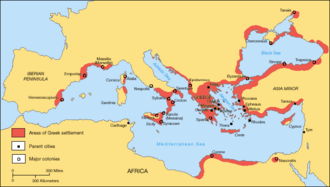
Map of Greek territories and colonies during the Archaic period. (800–480 BC)
In Archaic Greece, trading and colonizing activities of the Greek tribes from the Balkans and Asia Minor propagated Greek civilization, religion and language around the Mediterranean and Black Ocean basins. Greek city-states were established in Southern Europe, northern Libya and the Blackness Bounding main coast, and the Greeks founded over 400 colonies in these areas.[42] Alexander the Great's conquest of the Achaemenid Empire marked the beginning of the Hellenistic menstruum, which was characterized past a new moving ridge of Greek colonization in Asia and Africa; the Greek ruling classes established their presence in Arab republic of egypt, western asia, and Northwest Republic of india.[43] Many Greeks migrated to the new Hellenistic cities founded in Alexander's wake, as geographically-dispersed as Uzbekistan[44] and Kuwait.[45]
1450-1800 [edit]
Colonial settlers [edit]
The European continent has been a central role of a circuitous migration organization, which included swaths of Northward Africa, the Centre Due east and Asia Minor well earlier the Mod Era. Even so, simply the population growth of the late Middle Ages allowed for larger population movements, inside and outside of the continent.[46] The European exploration of the Americas stimulated a steady stream of voluntary migration from Europe. About 200,000 Spaniards settled in their American colonies prior to 1600, a small settlement compared to the iii to iv 1000000 Amerindians who lived in Spanish territory in the Americas.
Roughly one and a half million Europeans settled in the New World between 1500 and 1800 (encounter table). The Tabular array excludes European immigrants to the Spanish Empire from 1650-1800 and Portuguese clearing to Brazil from 1760 to 1800. While the absolute number of European emigrants during the early modernistic period was very small compared to afterwards waves of migration in the nineteenth and twentieth centuries, the relative size of these early mod migrations was nevertheless substantial.
During the 1500s, Espana and Portugal sent a steady flow of government and church officials, members of the lesser nobility, people from the working classes and their families averaging roughly iii-thousand people per twelvemonth from a population of around eight million. A full of effectually 437,000 left Kingdom of spain in the 150-year period from 1500 to 1650 to Central, South America and the Caribbean area Islands. Information technology has been estimated that over one.86 million Spaniards emigrated to Latin America in the period between 1492 and 1824, ane million in the 18th century, with millions more continuing to emigrate following independence.[47]
Between 1500 and 1700, 100,000 Portuguese crossed the Atlantic to settle in Brazil. Nevertheless, with the discovery of numerous highly productive gilded mines in the Minas Gerais region, the Portuguese emigration to Brazil increased by fivefold. From 1500, when the Portuguese reached Brazil, until its independence in 1822, from 500,000 to 700,000 Portuguese settled in Brazil, 600,000 of whom arrived in the 18th century alone.[48] From 1700 til 1760 over one-half a million Portuguese immigrants entered Brazil. In the 18th century, thanks to the gilt rush, the capital of the province of Minas Gerais, the boondocks of Vila Rica (today, Ouro Preto) became for a time 1 of the most populous cities in the New World. This massive influx of Portuguese immigration and influence created a city which remains to this twenty-four hours, one of the best examples of 18th century European architecture in the Americas.[38] However, the development of the mining economy in the 18th century raised wages and employment opportunities in the Portuguese colony and emigration increased: in the 18th century lone, about 600,000 Portuguese settled in Brazil.[49]
Betwixt ane-half and two-thirds of European immigrants to the 13 Colonies between the 1630s and the American Revolution came under indentures.[50] The practise was sufficiently common that the Habeas Corpus Act 1679, in part, prevented imprisonments overseas; information technology too fabricated provisions for those with existing transportation contracts and those "praying to be transported" in lieu of remaining in prison upon conviction.[51] In any example, while half the European immigrants to the Thirteen Colonies had been indentured servants, at any one time they were outnumbered by workers who had never been indentured, or whose indenture had expired. Gratis wage labor was more than mutual for Europeans in the colonies.[52] Indentured persons were numerically important mostly in the region from Virginia north to New Bailiwick of jersey. Other colonies saw far fewer of them. The total number of European immigrants to all thirteen colonies before 1775 was about 500,000-550,000; of these 55,000 were involuntary prisoners. Of the 450,000 or and then European arrivals who came voluntarily, Tomlins estimates that 48% were indentured.[53] About 75% were nether the age of 25. The age of legal adulthood for men was 24 years; those over 24 generally came on contracts lasting about iii years.[53] Regarding the children who came, Gary Nash reports that, "many of the servants were actually nephews, nieces, cousins and children of friends of emigrating Englishmen, who paid their passage in return for their labour once in America."[54] Figures for immigration the Spanish Empire 1650-1800 and Brazil 1700-1800 are not given in the Table.
| Number of European Emigrants 1500-1783 | |||
|---|---|---|---|
| Country of Origin | Number | Period | |
| Spain | 437,000 | 1500-1650 | |
| Portugal | 100,000 | 1500-1700 | |
| Portugal | 500,000 | 1700-1760 | |
| Uk | 400,000 | 1607-1700 | |
| U.k. (Totals) | 322,000 | 1700-1780 | |
| Scotland, Ireland | 190,000-25,000 | ||
| French republic | 51,000 | 1608-1760 | |
| Germany (Southwestern, Totals) | 100,000 | 1683-1783 | |
| Switzerland, Alsace-Lorraine | |||
| Totals | 1,410,000 | 1500-1783 | |
| Source: [38] | |||

In North America, clearing was dominated by British, Irish, French and other Northern Europeans.[55] Emigration to New French republic laid the origins of modern Canada, with important early on immigration of colonists from Northern France.[49]
Emigration in the 19th and 20th centuries [edit]
Mass European emigration to the Americas, South Africa, Australia and New Zealand took place in the 19th and 20th centuries. This was the effect of a dramatic demographic transition in 19th-century-Europe, subsequent wars and political changes on the continent. From the terminate of the Napoleonic Wars until 1920, some threescore million Europeans emigrated[ commendation needed ]. Of these, 71% went to North America, 21% to Latin America (mainly Argentina and Brazil) and vii% to Australia. About 11 million of these people went to Latin America, of whom 38% were Italians, 28% were Spaniards and eleven% were Portuguese.[56]

Vocalizer Carmen Miranda, nicknamed "the Brazilian bombshell", was born in Portugal and emigrated to Brazil in 1910, when she was ten months old.
Between 1821 and 1890, nine.55 million Europeans settled in the United States, mainly Germans, Irish, English, Scandinavians, Italians, Scots, and Poles.[ citation needed ] 18 1000000 more arrived from 1890 to 1914, including ii.5 million from Canada.[ citation needed ] Despite the large number of immigrants arriving, people born outside of the United States formed a relatively pocket-size number of the U.South. population: in 1910, foreigners accounted for fourteen.7 percent of the state's population or thirteen.5 meg people.[ citation needed ] The huge number of immigrants to Argentina, which had a much smaller population, had a much greater affect on the country'south ethnic composition. By 1914, 30% of Argentina's population was strange-born, with 12% of its population born in Italy, the largest immigrant grouping.[ citation needed ] Adjacent was Canada: past 1881, 14% of Canada'south population was foreign-born, and the proportion increased to 22% in 1921.[ citation needed ]
In Brazil, the proportion of immigrants in the national population was much smaller, and immigrants tended to exist concentrated in the central and Southern parts of the country. The proportion of foreigners in Brazil peaked in 1920, at just vii percentage or ii one thousand thousand people, mostly Italians, Portuguese, Germans and Spaniards; however, the influx of iv million European immigrants betwixt 1880 and 1920 significantly altered the racial composition of the country.[55] From 1901 to 1920, clearing was responsible for but 7 percent of Brazilian population growth, but in the years of high immigration, from 1891 to 1900, the share was equally high as thirty percent (higher than Argentine republic'due south 26 per centum in the 1880s).[57]
The countries in the Americas that received a major wave of European immigrants from 1820s to the early 1930s were: the U.s. (32.five million), Argentina (6.5 million), Canada (5 1000000),[ citation needed ] Brazil (4.3 million), Venezuela (2.1 million), Cuba (1.3 million), Chile (728,000),[58] Uruguay (713,000).[59] Other countries that received a more pocket-sized immigration flow (accounting for less than 10 percent of total European emigration to Latin America) were: Mexico (270,000), Colombia (126,000), Puerto Rico (62,000), Peru (30,000), and Paraguay (21,000).[59] [57]
Arrivals in the 19th and the 20th centuries [edit]
| European Emigrants 1800–1960 | |||
|---|---|---|---|
| Destination | Per centum | ||
| Usa | 70.0% | ||
| South America | 12.0% | ||
| Russian Siberia | ix.0% | ||
| Canada, Commonwealth of australia, New Zealand, South Africa | ix.0% | ||
| Full | 100.0% | ||
| Source: [threescore] [ pages needed ] [ failed verification ] | |||
| Destination | Years | Arrivals | Ref(due south) |
|---|---|---|---|
| United States | 1821–1932 | 32,244,000 | [58] |
| Argentina | 1856–1932 | 6,405,000 | [58] |
| Canada | 1831–1932 | 5,206,000 | [58] |
| Brazil | 1818–1932 | 4,431,000 | [58] |
| Commonwealth of australia | 1821–1932 | 2,913,000 | [58] |
| Cuba | 1901–1931 | 857,000 | [58] |
| Due south Africa | 1881–1932 | 852,000 | [58] |
| Chile | 1882–1932 | 726,000 | [58] |
| Uruguay | 1836–1932 | 713,000 | [58] |
| New Zealand | 1821–1932 | 594,000 | [58] |
| Mexico | 1911–1931 | 226,000 | [58] |
Legacy [edit]
Distribution [edit]
After the Age of Discovery, different ethnic European communities began to emigrate out of Europe with item concentrations in Commonwealth of australia, New Zealand, the United States, Canada, Argentina, Uruguay, Cuba, Costa rica, Brazil, Republic of chile, and Puerto Rico where they came to establish a European-descended majority population.[60] [61] [62] [63] It is important to annotation, however, that these statistics rely on identification with a European ethnic group in censuses, and as such are subjective (especially in the case of mixed origins). Nations and regions exterior of Europe with significant populations:[64]
Due north America [edit]
Total European population—approximately 300,000,000
Canada [edit]
In the start Canadian demography in 1871, 98.5% chose a European origin with information technology slightly decreasing to 96.3% declared in 1971.[65] [66] In the 2016 demography, nineteen,683,320 self-identified with a European ethnic origin, the largest being of British Isles origins (eleven,211,850). Individually, they are English (6,320,085), French (4,680,820), Scottish (iv,799,005), Irish gaelic (4,627,000), German (3,322,405), Italian (1,587,965).[8]
U.s.a. [edit]
At the fourth dimension of the first U.Southward. census in 1790, 80.7% of the American people self-identified as White, where it remained higher up that level, even reaching as loftier as xc% prior to the passage of the Clearing and Nationality Deed of 1965. Nevertheless, numerically it increased from 3.17 meg (1790) to 199.half dozen million exactly two hundred years afterward (1990).[67] Today, European Americans are the largest panethnic group in the Us.[ commendation needed ]
United mexican states [edit]

The European Mexican population is estimated by the government in 2010 every bit 47% of the population (56 one thousand thousand) using phenotypical traits (peel color) as the criteria.[17] [19] [68] [20] The employ of skin color palettes as the primary criteria to guess the ethnoracial groups that inhabit a given country has its origin in the investigations produced past Princeton and Vanderbilt Universities, which constitute information technology to exist more authentic than cocky-identification particularly in Latin America, where the dissimilar discourses that exist in regards to national identity accept rendered previous attempts to estimate indigenous groups unreliable.[69] If the criterion used is the presence of blond hair, it is xviii%[70] [71] - 23%.[72]
Caribbean and Central America [edit]

Cubans of European origin (primarily Spanish) reached its highest proportion during the early to mid twentieth century. In 1943 the census showed 74.iii% (3,553,312 people) self identified as (blanco) white.[73] [74]
In Costa Rica 83.7% of the population is White and Mestizo,[75] other sources judge unlike results between whites and mestizos,[76] [77] [78] Most are of Spanish and Italian descent,[79] nevertheless at that place are also German,[80] Polish[81] and French communities. During the terminal half of the 19th century and the offset half of the 20th century information technology welcomed more than 100,000 Europeans, mainly from Spain and Italy, it is estimated that about 50,000 Spaniards and Italians, ten,000 Germans and xl,000 Europeans of other nationalities, especially from French republic Poland and England.[82] [83] [84] [85] Costa rica had the greatest European migratory touch in Central America. When Costa rica became contained the population was barely 60,000 inhabitants.[86]
In El Salvador 12.vii% of the population is white,[87] 86.3% of the population were mestizo, having mixed european and amerindian ancestry. The majority being Spanish descendants from Galicia and Asturias. In El Salvador, settlement peaked betwixt 1880 to 1920, when 120,000 European and Arab immigrants entered the land, the Europeans were by and large Italians, Spanish and Germans.[88] [89]
In Republic of guatemala 5% of the population is white descent in their majority Spanish and High german. Many German language, Italian and Castilian Families arrived in Guatemala, the Germans for their role were the largest grouping, Immigration had a massive grapheme[90] [86]
S America [edit]
In Argentina 85% of the population or 38,416,407 are estimated to be of European descent.[6] [ failed verification ]
The Falkland Islanders are mainly of European, especially British descent and can trace their heritage back 9 generations or 200 years. In 2016, the census showed that 42.nine percent were native built-in and 27.4 percent were born in the U.K. (the second largest birthplace) for a total of more than 70 percent.[91] The Falkland Islands were entirely unoccupied and were first claimed past Great britain in 1765.[92] Settlers largely from Britain, peculiarly Scotland and Wales arrived after the 1830s. The full population of then islands grew from a 287 estimate in 1851 to 3,200 in the most contempo 2016 demography.[93] [94] The Origins of Falkland Islanders historically had a Gaucho presence.
In Republic of peru the official 2017 census, 5.9% or (ane.iii mil) 1,336,931 people 12 years of age and to a higher place self-identified their ancestors as White or of European descent.[95] : 214 This was the first time a question on race or ancestors had been asked since the 1940 census.[96] There were 619,402 (5.5%) males and 747,528 (half-dozen.iii%) females. The region with the highest proportion of Peruvians with self-identified European or white origins was in the La Libertad Region (x.5%), Tumbes Region and Lambayeque Region (ix.0%).[95] : 214 Most are descendants of early on Spanish settlers with substantial numbers of Italians and Germans.[96]
Australia and New Zealand [edit]
Using data from the 2016 census, it was estimated that around 58% of the Australian population were Anglo-Celtic Australians with 18% being of other European origins, a total of 76% for European ancestries as a whole.[97] As of 2016, the bulk of Australians of European descent are of English 36.ane%, Irish 11.0%, Scottish 9.three%, Italian 4.6%, German 4.v%, Greek 1.viii% and Dutch 1.half-dozen%. A large proportion —33.five%— chose to place equally 'Australian', nonetheless the census Bureau has stated that well-nigh of these are of quondam Anglo-Celtic colonial stock.[98] [99] [100]
Europeans historically (especially Anglo-Celtic) and presently are yet the largest indigenous group in New Zealand. Their proportion of the total New Zealand population has been decreasing gradually since the 1916 census where they formed 95.1 percent.[101] The 2018 official demography had over 3 1000000 people or 71.76% of the population were ethnic Europeans, with 64.1% choosing the New Zealand European option alone.[102]
Africa [edit]
Canary Islanders are the descendants of Spaniards who settled the Canary Islands. The Canarian people include long-tenured and new waves of Castilian immigrants, including Andalucians, Galicians, Castilians, Catalans, Basques and Asturians of Kingdom of spain; and Portuguese, Italians, Dutch or Flemings, and French. As of 2019, 72.one% or 1,553,078 were native Canary islanders with a further 8.ii% born in mainland Espana.[103] Many of European origins including those of Isleño (islander) lineage accept also moved to the islands, such as those from Venezuela and Cuba. Presently there are 49,170 from Italia, 25,619 from Federal republic of germany, Uk (25,521) and others from Romania, French republic and Portugal.[104]
Asia [edit]
In Asia, European-derived populations, (specifically Russians), predominate in North Asia and some parts of Northern Kazakhstan.[105]
Approximately 5-7 one thousand thousand Muslim migrants from the Balkans (from Bulgaria ane.15 meg-one.5 1000000; Greece ane.two meg; Romania, 400,000; Former Yugoslavia, 800,000), Russian federation (500,000), the Caucasus (900,000 of whom 2/3 remained the residue going to Syrian, Hashemite kingdom of jordan and Republic of cyprus) and Syria (500,000 generally as a result of the Syrian Civil War) arrived in Ottoman Anatolia and modern Turkey from 1783 to 2016 of whom iv million came by 1924, one.3 million came post-1934 to 1945 and more than one.2 million before the outbreak of the Syrian Ceremonious War. Today, betwixt a 3rd and a quarter of Turkey'southward population of almost 80 million take beginnings from these Muhacirs.[106]
Smaller communities [edit]
Small communities of European, live in the Persian Gulf countries of Bahrain, Kuwait, Qatar and the UAE; and in Aramco compounds in Saudi Arabia. Historically before 1970, small ethnic European (esp. Greek and Italian) enclaves were found in Egypt (Greeks in Arab republic of egypt, Italian Egyptians) and Syrian arab republic (Greeks in Syria). Also Israel has a small non-Jewish (frequently evangelical christian) American customs in a primarily ethnoreligious Jewish country.
Populations of European descent [edit]
- Albanian diaspora
- Kosovar diaspora
- Austrian diaspora
- Belarusian diaspora
- Belgian diaspora
- Flemish diaspora
- Bosnian diaspora
- British diaspora
- Cornish diaspora
- English diaspora
- Manx diaspora
- Scottish diaspora
- Welsh diaspora
- Bulgarian diaspora
- Croatian diaspora
- Czech diaspora
- Danish diaspora
- Dutch diaspora
- Estonian diaspora
- Finnish diaspora
- French diaspora
- Breton diaspora
- Corsican diaspora
- Quebec diaspora
- German diaspora
- Greek diaspora
- Greek Cypriot diaspora
- Hungarian diaspora
- Icelandic diaspora
- Irish gaelic diaspora
- Italian diaspora
- Calabrian diaspora
- Latvian diaspora
- Lithuanian diaspora
- Maltese diaspora
- Macedonian diaspora
- North Caucasian diaspora
- Chechen diaspora
- Circassian diaspora
- Norwegian diaspora
- Shine diaspora
- Kashubian diaspora
- Portuguese diaspora
- Romanian diaspora
- Moldovan diaspora
- Russian diaspora
- Serbian diaspora
- Slovak diaspora
- Slovenian diaspora
- Castilian diaspora
- Asturian diaspora
- Basque diaspora
- Canarian diaspora
- Catalan diaspora
- Galician diaspora
- Swedish diaspora
- Swiss diaspora
- Ukrainian diaspora
- Crimean Tatar diaspora
- Ruthenian/Rusyn diaspora
See also [edit]
- Emigration from Africa
- History of colonialism
- Immigration to Europe
- Indigenous people
- Western world
- Western culture
- White people
References [edit]
- ^ "Current Earth Population". Worldometers. July 2020. Retrieved 21 January 2022.
- ^ Based on the figures given per official census results.[ dubious ]
- ^ "ACS Demographic and Housing Estimates". U.Southward. Census Bureau. Dec 2019. Retrieved 23 March 2020.
- ^ Pena, Sérgio D. J.; Di Pietro, Giuliano; Fuchshuber-Moraes, Mateus; Genro, Julia Pasqualini; Hutz, Mara H.; Kehdy, Fernanda de Souza Gomes; Kohlrausch, Fabiana; Magno, Luiz Alexandre Viana; Montenegro, Raquel Carvalho; Moraes, Manoel Odorico; Moraes, Maria Elisabete Amaral de; Moraes, Milene Raiol de; Ojopi, Élida B.; Perini, Jamila A.; Racciopi, Clarice; Ribeiro-Dos-Santos, Ândrea Kely Campos; Rios-Santos, Fabrício; Romano-Silva, Marco A.; Sortica, Vinicius A.; Suarez-Kurtz, Guilherme (2011). "The Genomic Ancestry of Individuals from Different Geographical Regions of Brazil is More Uniform Than Expected". PLOS Ane. half dozen (2): e17063. Bibcode:2011PLoSO...617063P. doi:x.1371/periodical.pone.0017063. PMC3040205. PMID 21359226.
- ^ Schlesinger, David (2010). Ancestralidade da população de São Paulo e correlação com alterações neuropatológicas no idoso (Thesis). Universidade de São Paulo. doi:10.11606/T.41.2010.tde-17122010-142628.
- ^ a b c d east f g Lizcano Fernández, Francisco (August 2005). "Composición Étnica de las Tres Áreas Culturales del Continente Americano al Comienzo del Siglo XXI" [Ethnic Limerick of the Three Cultural Areas of the American Continent at the Beginning of the XXI Century]. Convergencia (in Spanish). 12 (38): 185–232.
- ^ "PEOPLE OF SIBERIA | Facts and Details".
- ^ a b Statistics Canada Demography Profile, 2016 Demography - Ethnic origin population
- ^ (PDF). ISBN9781850433996 https://psi424.cankaya.edu.tr/uploads/files/Zurcher,%20Turkey-A%20Mod%20Hist.PDF.
- ^ "Australian Homo Rights commission 2018" (PDF). 2018. Retrieved 23 July 2020.
- ^ Bushnell, David (2010). Rex A. Hudson (ed.). Colombia: A Land Study. U.Southward. Government Printing Office. p. 87. ISBN978-0-8444-9502-vi.
- ^ Schwartzman, Simon (2008). "Etnia, Condiciones de Vida y Discriminación" [Ethnicity, living conditions and discrimination]. In Valenzuela, Eduardo; Schwartzman, Simon; Scully, Timothy R.; Somma, Nicolas Thou.; Bihel, Andres (eds.). Vínculos, creencias e ilusiones: la cohesión social de los latinoamericanos (in Castilian). Uqbar Editores. pp. 61–72. ISBN978-956-8601-17-1.
- ^ "Resultado Basico del XIV Censo Nacional de Población y Vivienda 2011" [Basic Results of the XIV National Population and Housing Census 2011] (PDF) (in Spanish). Caracas: National Constitute of Statistics of the Bolivarian Republic of Venezuela. 9 Baronial 2012. p. 14. Retrieved 1 March 2017.
- ^ "Demográficos: Censos de Población y Vivienda: Población Proyectada al 2016 - Base Censo 2011" [Demographics: Population and Housing Censuses: Population Projected to 2016 - Census Base 2011] (in Castilian). National Found of Statistics. Retrieved 1 March 2017: adaption of the 42.2% white people from the census with current estimates
{{cite web}}: CS1 maint: postscript (link) - ^ a b c "Ethnic groups". The World Factbook. Central Intelligence Agency (CIA). Archived from the original on half dozen Jan 2019. Retrieved 14 September 2013.
- ^ "Composicion etnica del Peru". Retrieved 23 March 2022.
- ^ a b "21 de Marzo Día Internacional de la Eliminación de la Discriminación Racial" pag.vii, CONAPRED, Mexico, 21 March. Retrieved on 28 April 2017.
- ^ "Encuesta Nacional Sobre Discriminación en United mexican states", "CONAPRED", Mexico DF, June 2011. Retrieved on 28 Apr 2017.
- ^ a b "Resultados del Modulo de Movilidad Social Intergeneracional" Archived July nine, 2018, at the Wayback Machine, INEGI, 16 June 2017, Retrieved on thirty April 2018.
- ^ a b "Ser Blanco", El Universal, 06 July 2017, Retrieved on 19 June 2018.
- ^ "Cuba - The World Factbook". www.cia.gov. 14 December 2021.
- ^ "Census 2011 Census in brief, Report No. 03-01-41, p. 21" (PDF). Statistics Southward Africa. 2012. Retrieved 21 January 2016.
- ^ "Statistical Abstract of Israel, 2010 – Tabular array two.24 – Jews, by land of origin and age". Retrieved 22 March 2010.
- ^ Diez, Maria Sanchez. "Mapped: Where Sephardic Jews live afterward they were kicked out of Spain 500 years agone". Quartz . Retrieved twenty April 2021.
- ^ "Monthly Bulletin of Statistics". Cbs.gov.il. Retrieved 22 March 2011.
- ^ "Численность населения Республики Казахстан по отдельным этносам на начало 2020 года". Retrieved 6 August 2020.
- ^ "Cultural diversity". 2013 Census QuickStats almost national highlights. Statistics New Zealand. 3 December 2013. Retrieved 18 August 2017.
- ^ Cabella, Wanda; Mathías Nathan; Mariana Tenenbaum (December 2013). Juan José Calvo (ed.). Atlas sociodemográfico y de la desigualdad del Uruguay, Fascículo 2: La población afro-uruguaya en el Censo 2011: Ancestry [Atlas of socio-demographics and inequality in Uruguay, Role 2: The Afro-Uruguayan population in the 2011 Census] (PDF) (in Spanish). Uruguay National Institute of Statistics. ISBN978-9974-32-625-5. Archived from the original (PDF) on 9 February 2014.
- ^ Ethnic and Religious Multifariousness in Central America, PROLADES.
- ^ Instituto Nacional de Estadística y Censo del Ecuador INEC.
- ^ "Nicaragua Demographics Profile".
- ^ 2010 Census Data. "2010 Demography Information". 2010.demography.gov. Archived from the original on 2 Jan 2011. Retrieved 30 October 2011.
- ^ "Population – Land of Birth, Citizenship Category, State of Citizenship, Language, Religion, Ethnic/Religious Group, 2011". Statistical Service of the Republic of Republic of cyprus. Archived from the original on 12 June 2018. Retrieved 26 April 2016.
- ^ "Angola threat to end special relations with Portugal". 31 October 2013.
- ^ "Namibia vows to change 'status-quo' of white-subcontract ownership". News24.
- ^ Philip Jenkins, from "The Christian Revolution," in The Next Christendom: The Coming of Global Christianity, Oxford University Press, 2002.
- ^ The use of the term "diaspora" in reference to people of European national or ethnic origins is contested and debated- Diaspora and transnationalism : concepts, theories and methods. Bauböck, Rainer., Faist, Thomas, 1959-. Amsterdam: Amsterdam University Printing. 2010. ISBN9789089642387. OCLC 657637171.
{{cite book}}: CS1 maint: others (link) - ^ a b c "To Brand America": European Emigration in the Early Modern Catamenia edited by Ida Altman, James P. P. Horn (Page: 3 onwards)
- ^ De Lazzari, Chiara; Bruno Mascitelli (2016). "Migrant "Assimilation" in Commonwealth of australia: The Adult Migrant English Plan from 1947 to 1971". In Bruno Mascitelli; Sonia Mycak; Gerardo Papalia (eds.). The European Diaspora in Australia: An Interdisciplinary Perspective. Cambridge Scholars Publishing. p. 203. ISBN978-one-4438-9419-seven . Retrieved 28 February 2017.
- ^ a b "European Migration and Imperialism". historydoctor.internet. Archived from the original on 22 November 2010. Retrieved 14 September 2013.
The population of Europe entered its 3rd and decisive stage in the early on eighteenth century. Birthrates declined, but death rates also declined every bit the standard of living and advances in medical science provided for longer life spans. The population of Europe including Russia more than doubled from 188 1000000 in 1800 to 432 meg in 1900. From 1815 through 1932, sixty million people left Europe, primarily to "areas of European settlement," in North and South America, Commonwealth of australia, New Zealand and Siberia. These populations besides multiplied chop-chop in their new habitat; much more than and so than the populations of Africa and Asia. As a result, on the eve of World War I (1914), 38 percent of the world'southward total population was of European beginnings. This growth in population provided further impetus for European expansion, and became the driving force backside emigration. Rising populations put pressure level on land, and land hunger and led to "land hunger." Millions of people went abroad in search of work or economic opportunity. The Irish, who left for America during the great Potato famine, were an extreme simply not unique example. Ultimately, one third of all European migrants came from the British Isles between 1840 and 1920. Italians also migrated in large numbers because of poor economic conditions in their home country. High german migration also was steady until industrial conditions in Germany improved when the wave of migration slowed. Less than 1 half of all migrants went to the United States, although it absorbed the largest number of European migrants. Others went to Asiatic Russia, Canada, Argentina, Brazil, Australia and New Zealand.
- ^ "Cascade une approche démographique de l'expansion coloniale de l'Europe Bouda Etemad Dans Annales de démographie historique 2007/1 (due north° 113), pages 13 à 32".
- ^ Jerry H. Bentley, Herbert F. Ziegler, "Traditions and Encounters, two/due east," Chapter 10: "Mediterranean Lodge: The Greek Phase" Archived 2012-03-06 at the Wayback Car (McGraw-Loma, 2003)
- ^ Hellenistic Culture Archived July 5, 2008, at the Wayback Machine
- ^ "Menander became the ruler of a kingdom extending along the coast of western India, including the whole of Saurashtra and the harbour Barukaccha. His territory also included Mathura, the Punjab, Gandhara and the Kabul Valley", Bussagli p101
- ^ John Pike. "Failaka Isle". Globalsecurity.org . Retrieved xx April 2016.
- ^ Liberal states and the liberty of movement : selective borders, unequal mobility. Mau, Steffen, 1968-. Houndmills, Basingstoke, Hampshire: Palgrave Macmillan. 2012. ISBN9780230277847. OCLC 768167292.
{{cite book}}: CS1 maint: others (link) - ^ MacIas, Rosario Marquez; MacÍas, Rosario Márquez (1995). La emigración española a América, 1765-1824. ISBN9788474688566.
- ^ (Levy & Vasques 2014, p. 250) harv fault: no target: CITEREFLevyVasques2014 (help) [ full citation needed ]
- ^ a b Francis, R. D. (1988). Origins : Canadian history to Confederation . Jones, Richard, 1943-, Smith, Donald B. Toronto: Holt, Rinehart and Winston of Canada. ISBN978-0039217051. OCLC 16577780.
- ^ Galenson 1984: 1
- ^ Charles II, 1679: An Act for the ameliorate secureing the Liberty of the Subject and for Prevention of Imprisonments beyond the Seas., Statutes of the Realm: Volume 5, 1628–eighty, pp 935–938. Great U.k. Tape Committee, (1819)
- ^ Donoghue, John (October 2013). "Indentured Servitude in the 17th Century English language Atlantic: A Cursory Survey of the Literature: Indentured Servitude in the 17th Century English Atlantic". History Compass. 11 (10): 893–902. doi:ten.1111/hic3.12088.
- ^ a b Tomlins, Christopher (February 2001). "Reconsidering Indentured Servitude: European Migration and the Early American Labor Forcefulness, 1600–1775". Labor History. 42 (i): 5–43. doi:10.1080/00236560123269. S2CID 153628561.
- ^ Gary Nash, The Urban Crucible: The Northern Seaports and the Origins of the American Revolution (1979) p xv
- ^ a b Boris Fautos – Fazer a América: a imigração em massa para a América Latina."
- ^ Cánovas, Marília D. Klaumann (2004). "A grande emigração européia para o Brasil e o imigrante espanhol no cenário da cafeicultura paulista: aspectos de uma (in)visibilidade" [The great European immigration to Brazil and immigrants within the Spanish scenario of the Paulista coffee plantations: one of the problems (in) visibility]. Sæculum (in Portuguese). 11: 115–136.
- ^ a b Blanca Sánchez-Alonso (2005). "European Immigration into Latin America, 1870-1930" (PDF). docentes.atomic number 26.unl.pt. Archived from the original (PDF) on 22 October 2008.
- ^ a b c d e f g h i j k l Samuel L. Baily; Eduardo José Míguez (2003). Mass Migration to Modern Latin America. Rowman & Littlefield. p. xiv. ISBN978-0-8420-2831-8 . Retrieved xx Dec 2015.
- ^ a b Baily, Samuel L.; Míguez, Eduardo José, eds. (2003). Mass Migration to Modern Latin America. Wilmington, Delaware: Rowman & Littlefield. p. 14. ISBN978-0-8420-2831-8 . Retrieved 27 February 2017.
- ^ a b World Civilizations: Volume 2: Since 1500 By Philip J. Adler, Randall L. Pouwels
- ^ Francisco Hernández Delgado; María Dolores Rodríguez Armas (2010). "La emigración de Lanzarote y sus causas". Archivo Histórico Municipal de Teguise (www.archivoteguise.es) (in Spanish). Teguise, Lanzarote, Canary Islands: Departamento de Cultura y Patrimonio, Ayuntamiento de Teguise. Archived from the original on 27 July 2016. Retrieved 27 July 2016.
- ^ Ember et al 2004, p. 47 harvnb error: no target: CITEREFEmber_et_al2004 (help).
- ^ Marshall 2001, p. 254 harvnb fault: no target: CITEREFMarshall2001 (help).
- ^ Ethnic groups by country. Statistics (where bachelor) from CIA Factbook.
- ^ Ethnic origins Census of Canada (Folio: 17)
- ^ Tabular array 1: Population by Ethnic Origin, Canada, 1921-1971 Page: 2
- ^ "Official census statistics of the United States race and Hispanic origin population" (PDF). U.s.a. Statistics Bureau. Archived from the original (PDF) on 25 February 2010.
- ^ "Visión INEGI 2021 Dr. Julio Santaella Castell", INEGI, 03 July 2017, Retrieved on 30 April 2018.
- ^ "Americas Latinobarometer Insights: 2012", Vanderbit University, 2012, Retrieved on 26 June 2021.
- ^ "Stratification past Peel Colour in Contemporary Mexico", Jstor org, available creating a free account , Retrieved on 27 January 2018.
- ^ "Admixture in Latin America: Geographic Structure, Phenotypic Variety and Self-Perception of Ancestry Based on 7,342 Individuals" tabular array one, Plosgenetics, 25 September 2014. Retrieved on ix May 2017.
- ^ Ortiz-Hernández, Luis; Compeán-Dardón, Sandra; Verde-Flota, Elizabeth; Flores-Martínez, Maricela Nanet (April 2011). "Racism and mental health among university students in Mexico City". Salud Pública de México. 53 (2): 125–133. doi:10.1590/s0036-36342011000200005. PMID 21537803.
- ^ "El Color de la Piel según el Censo de Población y Viviendas - ONEI P17" (PDF) (in Spanish). Retrieved 22 January 2022.
- ^ Fernandez, Nadine T (xviii February 2010). Revolutionizing Romance: Interracial Couples in Contemporary Cuba. ISBN9780813549231 . Retrieved 21 Jan 2022.
- ^ "Resultados Generales Censo 2011" (PDF). 2011. Retrieved v August 2021.
- ^ Lizcano Fernández, Francisco (May–August 2005). "Composición Étnica de las Tres Áreas Culturales del Continente Americano al Comienzo del Siglo XXI" [Ethnic Composition of the 3 Cultural Areas of the American Continent at the Beginning of the 21st Century] (PDF). Convergencia. Revista de Ciencias Sociales (in Spanish). Toluca, México: Autonomous University of Mexico Country. 12 (38): 185–232.
- ^ "Republic of costa rica | Location, Geography, People, Culture, Economy, & History". Encyclopedia Britannica.
- ^ Chang-Rodriguez, Eugenio (29 October 2007). Latinoamerica: Su civilizacion y su cultura. ISBN978-1111801472.
- ^ "Italiana". Retrieved 5 Baronial 2021.
- ^ "Archived re-create". Archived from the original on 31 July 2020. Retrieved 21 May 2021.
{{cite web}}: CS1 maint: archived copy as title (link) - ^ "Migraciones Judías en Centroamérica y el Caribe: Proyección Epidemiológica de la Enfermedad de Gaucher" [Jewish Migrations in Central America and the Caribbean: Epidemiological Project of Gaucher Disease]. VITAE Academia Biómedica Digital (in Spanish). Vitae.ucv.ve (45). January–March 2011. ISSN 1317-987X. Retrieved 6 Apr 2022.
- ^ Porras, Carlos (xiii June 2016). "Mis libros con notas.: Inmigración española en Costa rica".
- ^ Acta académica (eJournal / eMagazine). [WorldCat.org]. 4 Jan 2019. OCLC 232114133. Retrieved 6 April 2022.
- ^ Perez-Siller, Javier (1998). México Francia: Memoria de una sensibilidad común; siglos XIX-XX. Tomo Two. ISBN9789686029789.
- ^ http://revistahistoria.historia.ucr.ac.cr/Numeros%20Anteriores/11/Herrera%20Balharry,%20Eugenio.%20Los%20inmigrantes%20y%20el%20poder%20en%20C.R.pdf [ expressionless link ]
- ^ a b Carlos Garcia684. "Inmigracion Europea En Centroamérica Después De La Colonia ( 1) : Free Download, Borrow, and Streaming : Internet Archive". Retrieved 6 Apr 2022.
- ^ "Republic of el salvador - The Globe Factbook". www.cia.gov. 29 March 2022.
- ^ "Ser extranjero en Centroamérica. Génesis y evolución de las leyes de extranjería y migración en El Salvador: siglos 19 y Xx". Retrieved 6 Apr 2022.
- ^ "Archived copy". Archived from the original on 29 June 2021. Retrieved 29 June 2021.
{{cite web}}: CS1 maint: archived copy as championship (link) - ^ "Archived copy". Archived from the original on 28 October 2014. Retrieved 29 June 2021.
{{cite spider web}}: CS1 maint: archived copy equally title (link) - ^ "2016 Falkland Island census report" (PDF). Falklandislandstimeline. p. 28. Retrieved 10 August 2020.
- ^ "Our People. Local life, traditions and services on the Islands". Falklands.gov.fk . Retrieved 10 August 2020.
- ^ "Falkland Island demography data tables". Fig.gov.fk . Retrieved 10 Baronial 2020. [ permanent dead link ]
- ^ "2016 Falkland Island census written report" (PDF). Falklandislandstimeline . Retrieved ten Baronial 2020.
- ^ a b "Perú: Perfil Sociodemográfico" (PDF). Instituto Nacional de Estadística e Informática . Retrieved 16 March 2020.
- ^ a b Valdivia, Néstor (2011). El uso de categorías étnico/raciales en censos y encuestas en el Perú: residuum y aportes para una discusión [The use of ethnic / racial categories in censuses and surveys in Peru: balance and contributions for a discussion] (in Spanish). GRADE Grouping for the Assay of Development. ISBN978-9972-615-57-3. [ page needed ]
- ^ "Australian Human Rights commission 2018" (PDF). 2018. Retrieved 12 December 2019.
- ^ Australian Bureau of Statistics has stated that most who listing "Australian" as their beginnings are part of the "Anglo-Celtic" grouping. "Characteristic Article - Indigenous and Cultural Diversity in Australia (Feature Commodity)". January 1995. Archived from the original on 20 Apr 2016. Retrieved 2008-06-24 .
- ^ "THE ANCESTRIES OF AUSTRALIANS Demography of Population and Housing: Reflecting Commonwealth of australia - Stories from the Demography, 2016". abs.gov.au . Retrieved 29 April 2020.
- ^ "Census of Population and Housing: Reflecting Commonwealth of australia - Beginnings 2016". abs.gov.au . Retrieved 29 April 2020.
- ^ "Historical and statistical survey (P. xviii)". Retrieved 29 April 2020.
- ^ "2018 Census totals by topic – national highlights". Stats NZ. 23 September 2019. Archived from the original on 23 September 2019. Retrieved 12 Dec 2019.
- ^ "Estadística del Padrón Continuo a 1 de enero de 2019. Datos a nivel nacional, comunidad autónoma y provincia". Retrieved 20 February 2020.
- ^ Canarias gana en un año 24.905 habitantes, el 66% de otros países Canarias7.es. Retrieved v October 2019
- ^ Hill, Fiona (23 February 2004). "Russian federation — Coming In From the Common cold?". The Globalist. Archived from the original on 15 July 2011.
- ^ Bosma, Lucassen & Oostindie 2012, 17 harvnb error: no target: CITEREFBosmaLucassenOostindie2012 (help)
grahamwilyingeld83.blogspot.com
Source: https://en.wikipedia.org/wiki/European_emigration
0 Response to "what percentage of europeans would like to move to america?"
Post a Comment